How Louvre thieves exploited human psychology to avoid suspicion—and what it reveals about AI
19 November 2025
For humans and AI, when something fits the category of “ordinary,” it slips from notice.
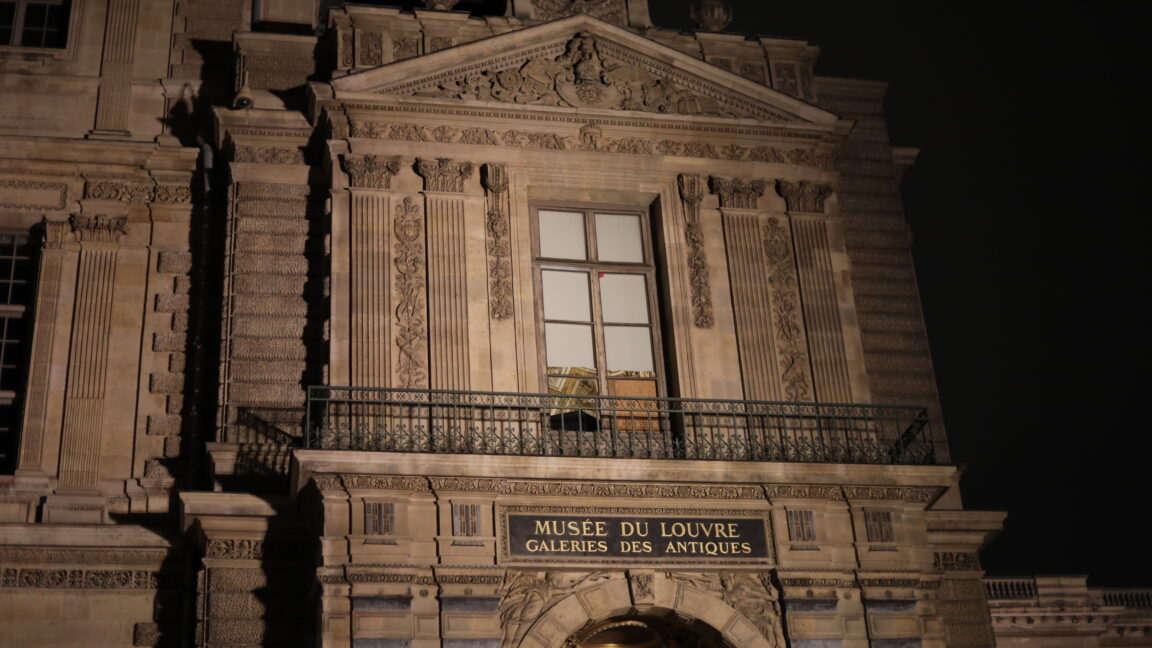
On a sunny morning on October 19 2025, four men allegedly walked into the world’s most-visited museum and left, minutes later, with crown jewels worth 88 million euros ($101 million). The theft from Paris’ Louvre Museum—one of the world’s most surveilled cultural institutions—took just under eight minutes.
Visitors kept browsing. Security didn’t react (until alarms were triggered). The men disappeared into the city’s traffic before anyone realized what had happened.
Investigators later revealed that the thieves wore hi-vis vests, disguising themselves as construction workers. They arrived with a furniture lift, a common sight in Paris’s narrow streets, and used it to reach a balcony overlooking the Seine. Dressed as workers, they looked as if they belonged.
This strategy worked because we don’t see the world objectively. We see it through categories—through what we expect to see. The thieves understood the social categories that we perceive as “normal” and exploited them to avoid suspicion. Many artificial intelligence (AI) systems work in the same way and are vulnerable to the same kinds of mistakes as a result.
The sociologist Erving Goffman would describe what happened at the Louvre using his concept of the presentation of self: people “perform” social roles by adopting the cues others expect. Here, the performance of normality became the perfect camouflage.
The sociology of sight
Humans carry out mental categorization all the time to make sense of people and places. When something fits the category of “ordinary,” it slips from notice.
AI systems used for tasks such as facial recognition and detecting suspicious activity in a public area operate in a similar way. For humans, categorization is cultural. For AI, it is mathematical.
But both systems rely on learned patterns rather than objective reality. Because AI learns from data about who looks “normal” and who looks “suspicious,” it absorbs the categories embedded in its training data. And this makes it susceptible to bias.
The Louvre robbers weren’t seen as dangerous because they fit a trusted category. In AI, the same process can have the opposite effect: people who don’t fit the statistical norm become more visible and over-scrutinized.
It can mean a facial recognition system disproportionately flags certain racial or gendered groups as potential threats while letting others pass unnoticed.
A sociological lens helps us see that these aren’t separate issues. AI doesn’t invent its categories; it learns ours. When a computer vision system is trained on security footage where “normal” is defined by particular bodies, clothing, or behavior, it reproduces those assumptions.
Just as the museum’s guards looked past the thieves because they appeared to belong, AI can look past certain patterns while overreacting to others.
Categorization, whether human or algorithmic, is a double-edged sword. It helps us process information quickly, but it also encodes our cultural assumptions. Both people and machines rely on pattern recognition, which is an efficient but imperfect strategy.
A sociological view of AI treats algorithms as mirrors: They reflect back our social categories and hierarchies. In the Louvre case, the mirror is turned toward us. The robbers succeeded not because they were invisible, but because they were seen through the lens of normality. In AI terms, they passed the classification test.
From museum halls to machine learning
This link between perception and categorization reveals something important about our increasingly algorithmic world. Whether it’s a guard deciding who looks suspicious or an AI deciding who looks like a “shoplifter,” the underlying process is the same: assigning people to categories based on cues that feel objective but are culturally learned.
When an AI system is described as “biased,” this often means that it reflects those social categories too faithfully. The Louvre heist reminds us that these categories don’t just shape our attitudes, they shape what gets noticed at all.
After the theft, France’s culture minister promised new cameras and tighter security. But no matter how advanced those systems become, they will still rely on categorization. Someone, or something, must decide what counts as “suspicious behavior.” If that decision rests on assumptions, the same blind spots will persist.
The Louvre robbery will be remembered as one of Europe’s most spectacular museum thefts. The thieves succeeded because they mastered the sociology of appearance: They understood the categories of normality and used them as tools.
And in doing so, they showed how both people and machines can mistake conformity for safety. Their success in broad daylight wasn’t only a triumph of planning. It was a triumph of categorical thinking, the same logic that underlies both human perception and artificial intelligence.
The lesson is clear: Before we teach machines to see better, we must first learn to question how we see.
Vincent Charles, Reader in AI for Business and Management Science, Queen’s University Belfast, and Tatiana Gherman, Associate Professor of AI for Business and Strategy, University of Northampton. This article is republished from The Conversation under a Creative Commons license. Read the original article.
Related Posts
You might also enjoy these articles on similar topics: